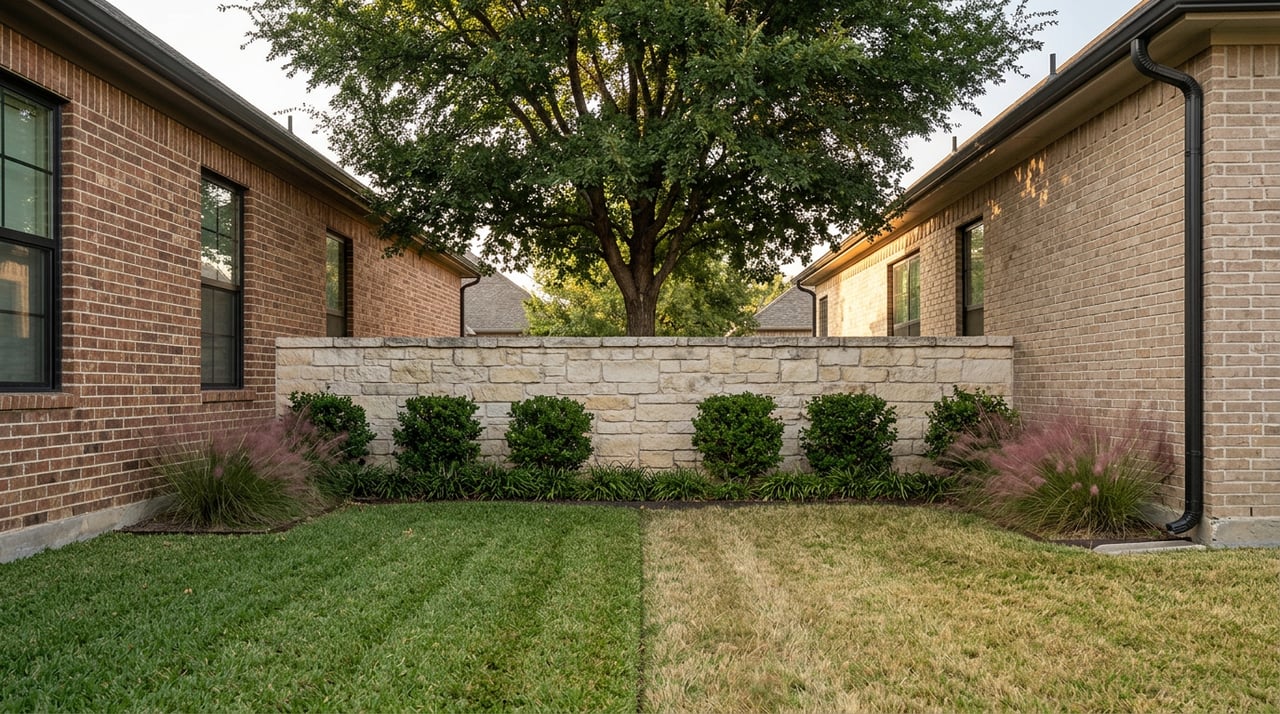
Flower Mound Isn't One Housing Market. Your Address Decides Which One You're In.
September 17, 2026
September 17, 2026
Ask two homeowners in Flower Mound's 75022 ZIP code what their effective property tax rate is, and you can get answers as far apart as 1.57 percent and 2.02 percent. Same five digits on the envelope. Same town limits. The difference isn't the school rating or the size of the lot. It's which county line the parcel happens to sit on, and which of five school districts collects a levy from it.
That's the part the median price on a portal search never tells you. "Flower Mound" reads like a single market with a single number attached to it. On the ground, it's a patchwork of overlapping jurisdictions where the address, not the neighborhood name, decides your school assignment, your county, and a meaningful share of your annual tax bill.
Flower Mound sits almost entirely in Denton County, with a smaller slice extending south into Tarrant County along the Grapevine Lake shoreline. Property tax analysis from Ownwell, which breaks out effective rates by county and ZIP code, shows just how differently that split plays out depending on which side of the line a home falls on.
On the Denton County side, the spread between ZIP codes is modest: 75028 runs a median effective rate around 1.66 percent, while 75022 comes in a bit lower at 1.57 percent, a gap of roughly a tenth of a percentage point. Cross into the Tarrant County portion of those same two ZIP codes, and the gap nearly triples: 75022 there carries a median effective rate around 2.02 percent, against 1.74 percent in 75028.
| County portion | ZIP 75022 | ZIP 75028 | Spread |
|---|---|---|---|
| Denton County | ~1.57% | ~1.66% | ~0.09 pts |
| Tarrant County | ~2.02% | ~1.74% | ~0.28 pts |
One number that does stay constant no matter which side of that line a house sits on is the Town of Flower Mound's own municipal rate, currently $0.387277 per $100 of assessed value for fiscal year 2025-26. That figure is the same for every taxpayer in town. Everything layered on top of it, the county rate, the school district levy, and in some subdivisions a water or utility district assessment, is where the map starts to fracture. A buyer comparing two listings a few blocks apart isn't just comparing square footage and finish-out. They're often comparing two different combinations of taxing authority that happen to share a mailing address format.
The tax split has a twin: a school district split that cuts across the same town in a different pattern. Lewisville ISD serves the majority of Flower Mound, but Argyle ISD, Northwest ISD, Denton ISD, and Grapevine-Colleyville ISD each serve a piece of it too, with Grapevine-Colleyville picking up the portion that falls inside Tarrant County. The Town of Flower Mound's own school resources page confirms the arrangement in plain terms: the majority of town is Lewisville and Argyle, with the other three districts covering smaller areas.
What makes this genuinely tricky for anyone comparing homes is that assignment runs address by address, not neighborhood by neighborhood. Canyon Falls, the roughly 1,242-acre nature-focused community built around limestone canyon terrain and creek corridors, is a clean example: about 626 of those acres sit within Flower Mound, with the rest spilling into Northlake and Argyle. Because the community crosses three jurisdictions, the school district, the municipality, and even which entity provides certain services depends on the exact section of the development a home sits in, not the community's name on the sign at the entrance.
Furst Ranch, one of the newer developments on the western edge of town, tells a similar story from the opposite direction. It's zoned primarily to Argyle ISD, while much of central and eastern Flower Mound, developed decades earlier under a different set of boundaries, is Lewisville ISD. Two homes can carry the same "Flower Mound" address on paper and sit in entirely different districts, entirely different feeder patterns, and in the Tarrant County sliver, entirely different counties.
None of this is frozen in place, and the last two years are proof. In December 2024, facing a budget shortfall tied to flat state funding formulas and declining enrollment, the Lewisville ISD Board of Trustees voted to retire five elementary campuses at the end of the 2024-25 school year: B.B. Owen, Creekside, Garden Ridge, Highland Village, and Polser Elementary STEM Academy. The closures triggered boundary adjustments across a wider set of campuses for the 2025-26 school year, including a shift that sent Flower Mound Elementary students into the Downing Middle School zone rather than splitting them between Downing and Lamar, and a rezoning that moved the Lakeside mixed-use development from Bluebonnet Elementary to Old Settlers Elementary.
The district followed up in January 2025 by expanding a grandfather policy, letting some students affected by the closures and rezoning stay at their original campus through certain grade levels rather than switching schools immediately. That's a small mercy for the families it applied to, but it doesn't undo the underlying point: the boundary a home sits inside today is not guaranteed to be the boundary it sits inside in three years.
The clearest sign that the ripple effects are still working their way through town came just this past June. The Flower Mound Town Council voted to remove reduced-speed school zones near the intersection of Morriss Road and College Parkway, a direct consequence of the Garden Ridge Elementary closure. With that campus gone and the Lamar and Downing Middle School boundaries redrawn around it, town documents noted there was no longer a need for a crossing guard at that intersection because there were no longer school-age children walking through it. A school district decision made at a board table in December 2024 was still changing what a stretch of pavement looked like a year and a half later.
None of this is a reason to avoid Flower Mound. It's a reason to stop treating the town as a single, uniform data point. A few habits make the difference:
Does a half-mile difference in address really change my school district? It can. Because assignment runs by specific parcel rather than by neighborhood, two homes on the same street, or even in the same subdivision phase, can be zoned to different elementary, middle, or high schools depending on which side of a drawn boundary line they fall on.
If my boundary gets redrawn after I buy, does my tax rate change too? Not automatically, but it can shift the total bill over time, since the school district levy is one of the components stacked on top of the town's flat municipal rate. A rezoning that moves a home from one district to another moves it to a different levy as well.
If you're comparing two Flower Mound addresses and want a clear read on which district, which county, and which combination of levies actually applies to each one before you get attached to either, that's exactly the kind of groundwork Mikel Porter Real Estate Group walks through with clients from the first conversation. Reach out for a free home valuation and a straight answer on what your specific address means for your bottom line.
Stay up to date on the latest real estate trends.


The Mikel Porter Real Estate Group is more than just a real estate team; we are trusted advisors, skilled negotiators, and dedicated partners on your real estate journey. Contact us today!