
The Flower Mound Tree Rule That Outlives the Builder Who Signed It
August 27, 2026
August 27, 2026
Say you close on a resale home in an established Flower Mound neighborhood. The lot has a mature live oak near the back fence, right where you had planned to put a pool. You assume this is a landscaping decision, something between you and a contractor. Then you call for a tree removal permit and learn the tree was never yours to remove on your own terms in the first place.
This catches people off guard because most buyers think of tree rules as a builder's problem, something that got settled during construction years before the house ever sold. In Flower Mound, that assumption is wrong. The town's tree preservation ordinance does not expire when a certificate of occupancy is issued. It attaches to the lot, and in some cases it can follow the property through multiple owners long after the original developer has moved on to the next subdivision.
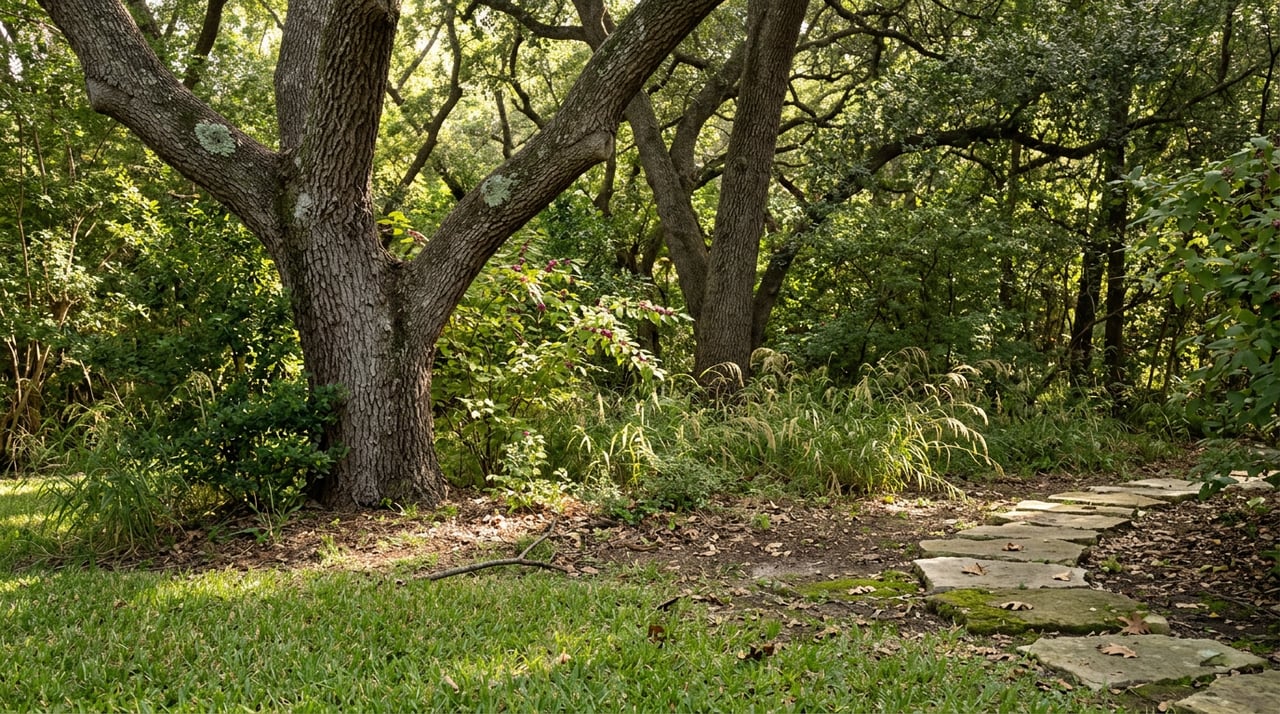
Flower Mound's tree ordinance, found in Chapter 94 of the town's Code of Ordinances, sets the bar low. A protected tree is any native or established tree measuring more than six inches in diameter at four and a half feet off the ground. That threshold sounds technical until you picture what it actually covers. Six inches of trunk diameter describes a tree that has been in the ground for years, not decades. In neighborhoods built out in the 1990s and 2000s, that means the shade tree in the side yard, the oak by the driveway, and the cedar elm near the property line all likely qualify.
The requirements scale with lot size. If a lot is one acre or larger, the town requires a full tree survey prepared by an ISA-certified arborist or a registered landscape architect, with every protected tree over six inches marked and measured. Smaller lots, which describes most of the established, move-up neighborhoods where buyers are competing for homes near Highland Village and Grapevine Lake, only need a plot plan showing the approximate size, canopy spread, and location of trees relative to the building pad. Lower documentation burden, but the same underlying protection.
Here is the number that actually changes a renovation budget. If you remove a protected tree, the ordinance does not require a one-for-one swap. It requires replacement trees totaling one and a half times the caliper width of what came down.
The town's own code spells out the example plainly: a six-inch protected tree removed under permit must be replaced with trees providing a combined caliper width of nine inches. That can be satisfied with a single nine-inch tree, three three-inch trees, or any combination that adds up.
| Removed tree (caliper) | Required replacement caliper | One way to satisfy it |
|---|---|---|
| 6 inches | 9 inches | One 9-inch tree, or three 3-inch trees |
| 10 inches | 15 inches | One 15-inch tree, or five 3-inch trees |
| 20 inches | 30 inches | Combination approved by the tree preservation officer |
Replacement trees have to be container-grown, meet minimum caliper and height standards, and go in locations the town's tree preservation and enforcement officer signs off on. If planting that many trees on a suburban lot is not realistic, the ordinance allows a payment instead, deposited into the town's fund for supplemental plantings in public areas rather than the applicant's yard. Locally, this option is sometimes referred to as paying into the Reforestation Fund. Either way, the obligation does not disappear. It converts from trees to dollars.
This is the part that surprises resale buyers most. When a subdivision was originally platted, the developer often agreed, as a condition of getting that plat approved, to preserve specific trees on specific lots. Those agreements are not personal to the builder. They run with the land.
The ordinance states it directly: trees that were the subject of such a preservation agreement remain protected regardless of species or caliper, and unauthorized removal of one of those trees can result in revocation of the development plan and record plat for that property for sixty months.
Read that again from a buyer's chair. You did not sign that original agreement. You may not have known it existed. But if the tree in question was part of the preservation commitment made when your neighborhood was platted, taking it down without a permit can put your specific lot's plat status in limbo for five years, a problem that surfaces at the worst possible time, usually when you are trying to pull a permit for something unrelated, like a pool or an addition.
None of this means mature trees are off limits. It means the sequence matters. Before writing an offer that assumes you will clear a tree, reroute a fence line, or reshape a backyard for a pool, a few checks are worth doing while you still have time to negotiate:
None of this is disclosed to you automatically at closing the way a survey or a title commitment is. It lives in town records and in the original development plan, which means it takes a specific question, asked early, to surface it.
Dollar figures around tree preservation in Flower Mound have been debated publicly before. During a 2016 town council discussion over where to set the caliper threshold for specimen trees, a local developer estimated that fencing off the drip line of each individual protected tree during construction, a requirement meant to prevent root and trunk damage from equipment, could run around fifteen hundred dollars per tree on a larger site. That number came from a builder actively working through the process, not from a hypothetical. It illustrates the order of magnitude at stake once mitigation, fencing, and replacement planting are all added up on a project involving more than a tree or two.
For a homeowner dealing with a single backyard oak rather than a subdivision-scale development, the math is smaller but still real. Between the caliper replacement requirement, the option to pay into the town's fund instead, and the arborist fees involved in documenting everything correctly, a tree that looked like a simple landscaping decision can turn into a four-figure line item before the first shovel goes in the ground.
Does this apply to every lot in Flower Mound, or just newer construction? It applies broadly across the town, though the documentation burden differs by lot size. Established resale lots under an acre generally need only a plot plan rather than a full arborist survey, but the protected-tree threshold and mitigation requirements apply regardless of when the home was built.
What if a previous owner already removed a tree without a permit? That history stays with the property, not the person who did it. It is one more reason to check the address in the town's violation search before assuming a clear yard has always been that way by choice.
Do dead or diseased trees count as protected? The town's process accounts for tree health, and a certified arborist's documentation of decay, disease, or hazard condition factors into how removal requests are handled. It is a different conversation than removing a healthy tree simply because it is in the way of a project.
Trees are one of the quieter things that make Flower Mound feel the way it does, and the ordinance behind them is more durable than most buyers expect. If you are weighing a lot with an eye toward a pool, an addition, or just a different yard, it is worth having that conversation before you write the offer, not after you own the problem.
If you are working through what a specific Flower Mound lot allows, or want a second set of eyes on a property before you get too attached to a backyard plan, reach out to Mikel Porter Real Estate Group. A conversation now costs nothing and can save a renovation timeline later.
Stay up to date on the latest real estate trends.


The Mikel Porter Real Estate Group is more than just a real estate team; we are trusted advisors, skilled negotiators, and dedicated partners on your real estate journey. Contact us today!